







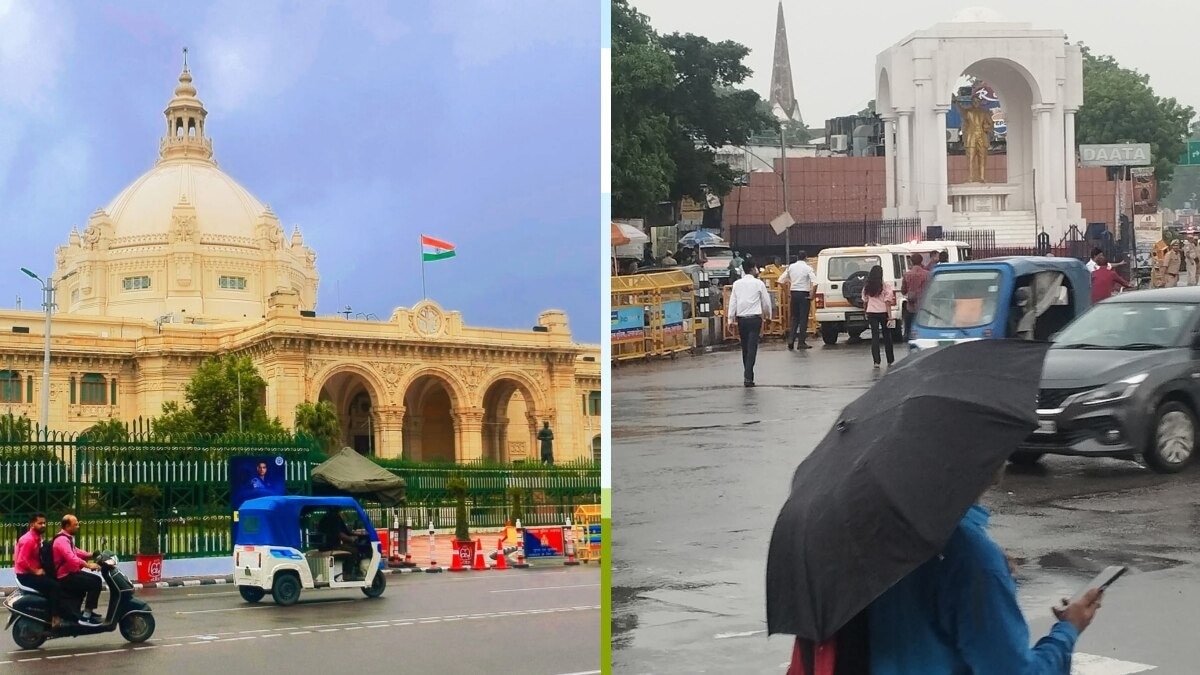
On Sunday, June 14, India faces three weather systems at once: a western disturbance soaking the northwest, the southwest monsoon climbing up from the south, and a heat wave gripping central India.



Here is what the IMD forecast means and the simple science behind it. A tale of two Indias on June 14: scorching, hazy skies over Delhi contrasting with rain clouds gathering over Kerala and the northeast. New Delhi,UPDATED: Jun 13, 2026 19:43 ISTIndia is being pulled in two directions at once. From the northwest, a system born thousands of kilometres away over the Mediterranean Sea is wringing rain over the hills and plains.
From the south and the east, the southwest monsoon is climbing steadily up the map.
Caught in the middle, a slice of central India is still baking. On Sunday, June 14, the country has three completely different skies on the same afternoon.
A STORM THAT TRAVELLED FROM THE MEDITERRANEANThe rain over Jammu and Kashmir, Himachal Pradesh, Uttarakhand, Punjab, Haryana, Delhi and west Uttar Pradesh is being driven by what meteorologists call a western disturbance. The name is dull, but the thing itself is a genuine traveller.
It is a low-pressure storm that forms over the Mediterranean Sea and rides eastward on the subtropical jet stream, a fast ribbon of wind high in the atmosphere, until it strikes the Himalayas and spills its moisture over the subcontinent.
On Sunday, June 14, three different weather systems are shaping the skies across India at the same time.
(Photo: PTI) The India Meteorological Department (IMD) describes the current one as a cyclonic circulation sitting over north Haryana. A cyclonic circulation is simply a swirl of winds turning anticlockwise around a centre of low pressure, the same rotation that, on a far larger and more violent scale, powers a cyclone.
This one is mild, but strong enough to fire off thunderstorms with gusty winds of 50 to 60 kmph across the northwest, easing afterwards. THE MONSOON IS STILL CLIMBING THE MAPWhile the northwest draws its rain from the west, the south and east are fed by the southwest monsoon, the seasonal flip in wind direction that hauls moisture off the warm Indian Ocean and pours it over land between June and September. The IMD tracks the advance with a line on the map called the Northern Limit of Monsoon, the leading edge of monsoon rain.
On June 14, India has three skies at once: rain in the northwest from a western disturbance, the monsoon climbing up the south and east, and a heat wave still baking central India.
Here is the simple science behind it.
(Photo: PTI) As on June 13, that line ran through Solapur, Hyderabad, Kalingapatnam, Paradeep, Purulia, Dhanbad and Muzaffarpur.
Conditions are right for the rains to push into the rest of Karnataka, Telangana, Andhra Pradesh and West Bengal, more of Odisha and parts of south Chhattisgarh over the next two to three days. It is already delivering.
In the 24 hours to the morning of June 13, isolated spots in Assam and South Interior Karnataka recorded 12 to 20 cm of rain, which the IMD classes as heavy to very heavy. WHERE THE HEAT REFUSES TO LEAVEIn between, a pocket of central India has missed both systems.
Heat wave conditions are likely over Marathwada and Madhya Maharashtra over the next two days, and over Vidarbha until June 15. A heat wave is declared when the temperature crosses 40 degrees Celsius in the plains and runs well above the seasonal normal.
On June 12, Jaisalmer in Rajasthan was the country's hottest place at 44. 2 degrees Celsius. For Delhi, June 14 brings a partly cloudy sky, the chance of an afternoon thundery burst, and highs of 37 to 39 degrees Celsius. - EndsPublished By: Radifah KabirPublished On: Jun 13, 2026 19:43 IST